

Who Received The Money By Paying A Toll On The Highway?
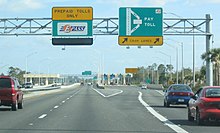
A toll road, also known as a tollway, or as a turnpike in the United states of america, is a public or private road (almost always a controlled-access highway), for the use of which a fee (or toll) is paid. It is a form of route pricing, typically implemented to help recoup the costs of road construction and maintenance.
Cost roads have existed in some form since artifact, with tolls levied on passing travelers on foot, wagon, or horseback, a practice that continued with the machine. Many modernistic tollways charge fees for motor vehicles exclusively. The amount of the toll usually varies by vehicle type, weight, or number of axles, with freight trucks frequently charged college rates than cars.
Tolls tin can exist nerveless at cost plazas, price booths, toll houses, toll stations, cost bars, cost barriers, or toll gates. Some price drove points are automated, and the user deposits money in a machine which opens the gate once the right toll has been counted. To cut costs and minimise time delay, many tolls are nerveless with electronic toll drove equipment, which automatically communicates with a transponder in the toll payer'south vehicle, or uses automatic number-plate recognition, to charge drivers by debiting their existing accounts.
Criticisms of price roads include the time taken to stop and pay the toll, and the cost of the toll booth operators — upwards to virtually ane-tertiary of acquirement in some cases. Automatic toll-paying systems help minimise both of those problems. Others object to paying "twice" for the same route: both in fuel taxes and in tolls.
In add-on to toll roads, toll bridges and cost tunnels are also used by public authorities to generate funds to repay the price of building the structures. Some tolls are prepare aside to pay for hereafter maintenance or the enhancement of infrastructure, or are applied as a general fund by local governments, not being earmarked for transport facilities. That is sometimes limited or prohibited by cardinal regime legislation. Likewise, road congestion pricing schemes accept been implemented in some urban areas equally a transportation need management tool, in an effort to reduce traffic congestion and air pollution.[1]
History [edit]
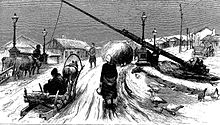

Entrance fees drove in a local customs road checkpoint about Bagan (Myanmar)
Ancient times [edit]
Toll roads have existed for at to the lowest degree the concluding 2,700 years, as tolls had to be paid by travellers using the Susa–Babylon highway under the government of Ashurbanipal, who reigned in the 7th century BC.[2]
Aristotle and Pliny refer to tolls in Arabia and other parts of Asia. In India, before the fourth century BC, the Arthashastra notes the use of tolls. Germanic tribes charged tolls to travellers across mountain passes.
Middle Ages [edit]
Most roads were not freely open to travel on in Europe during the Eye Ages,[3] and the toll was one of many feudal fees paid for rights of usage in everyday life. Some major European "highways", such as the Via Regia and Via Imperii, offered protection to travelers in commutation for paying the regal cost.
Many modern European roads were originally constructed as price roads in order to recoup the costs of construction and maintenance, and to generate acquirement from passing travelers. In 14th-century England, some of the virtually heavily used roads were repaired with money raised from tolls by pavage grants. Widespread toll roads sometimes restricted traffic so much, by their high tolls, that they interfered with trade and cheap transportation needed to alleviate local famines or shortages.[4]
Tolls were used in the Holy Roman Empire in the 14th and 15th centuries.
17th-century Dahomey [edit]
Later significant road construction undertaken by the Westward African kingdom of Dahomey, toll booths were also established with the function of collecting yearly taxes based on the goods carried past the people of Dahomey and their occupation. In some cases, officials imposed fines for public nuisance before allowing people to pass.[5]
19th century [edit]
Industrialisation in Europe needed major improvements to the transport infrastructure which included many new or substantially improved roads, financed from tolls. The A5 route in Britain was built to provide a robust transport link between Britain and Republic of ireland and had a toll house every few miles.
20th century [edit]
In the 20th century, road tolls were introduced in Europe to finance the structure of motorway networks and specific transport infrastructure such as bridges and tunnels. Italy was the beginning European country to charge motorway tolls, on a 50 kilometres (31 mi) superhighway section nearly Milan in 1924. It was followed by Greece, which made users pay for the network of motorways effectually and between its cities in 1927. Later on in the 1950s and 1960s, France, Spain, and Portugal started to build motorways largely with the assistance of concessions, assuasive rapid evolution of this infrastructure without massive state debts. Since and then, road tolls accept been introduced in the majority of the EU member states.[6]
In the United States, prior to the introduction of the Interstate Highway System and the large federal grants supplied to states to build it, many states synthetic their offset controlled-access highways by floating bonds backed past toll revenues. Starting with the Pennsylvania Turnpike in 1940, and followed by similar roads in New Jersey (New Jersey Turnpike, 1952 and Garden Land Parkway, 1954), New York (New York State Thruway, 1954), Massachusetts (Massachusetts Turnpike, 1957), Illinois (Illinois Tollway, 1958), and others, numerous states throughout the 1950s established major toll roads. With the institution of the Interstate Highway System in the late 1950s, toll road construction in the U.Southward. slowed down considerably, every bit the federal regime at present provided the bulk of funding to construct new freeways, and regulations required that such Interstate highways be free from tolls. Many older toll roads were added to the Interstate Arrangement under a grandfather clause that allowed tolls to continue to exist collected on toll roads that predated the system. Some of these such every bit the Connecticut Turnpike and the Richmond–Petersburg Turnpike later removed their tolls when the initial bonds were paid off. Many states, however, have maintained the tolling of these roads every bit a consequent source of acquirement.
As the Interstate Highway Arrangement approached completion during the 1980s, states began constructing toll roads once again to provide new controlled-admission highways which were non part of the original interstate system funding. Houston'due south outer beltway of interconnected toll roads began in 1983, and many states followed over the last two decades of the 20th century calculation new cost roads, including the tollway system effectually Orlando, Florida, Colorado's E-470, and Georgia State Road 400.
21st century [edit]
London, in an attempt to reduce traffic within the city, instituted the London congestion charge in 2003, effectively making all roads inside the eye of the city tolled.

In the United States, every bit states looked for ways to construct new freeways without federal funding again, to raise revenue for continued road maintenance, and to command congestion, new cost road structure saw significant increases during the first two decades of the 21st century. Spurred on by two innovations, the electronic toll drove system, and the advent of loftier-occupancy and express lane tolls, many areas of the U.S saw large road edifice projects in major urban areas. Electronic toll collection, first introduced in the 1980s, reduces operating costs by removing toll collectors from roads. Tolled express lanes, past which certain lanes of a throughway are designated "toll but", increases revenue past allowing a free-to-use highway to collect revenue by allowing drivers to bypass traffic jams past paying a toll.
The E-ZPass system, compatible with many country systems, is the largest ETC organization in the U.S., and is used for both fully tolled highways and tolled express lanes. Maryland Route 200 and the Triangle Pike in North Carolina were the first toll roads built without toll booths, with drivers charged via ETC or by optical license plate recognition and are billed by mail. In improver, many older toll roads are also being upgraded to an all-electronic tolling arrangement, abandoning the hybrid systems they adopted during the late 20th century. These include the Massachusetts Turnpike, one of the oldest American cost roads, which went all-electronic in 2016, and the Pennsylvania Turnpike, America's oldest toll freeway, which went all-electronic in 2020.

U.k. turnpikes [edit]
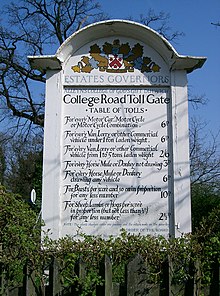
Turnpike trusts were established in England and Wales from about 1706 in response to the demand for better roads than the few and poorly-maintained tracks and so available. Turnpike trusts were set upward by individual Acts of Parliament, with powers to collect route tolls to repay loans for edifice, improving, and maintaining the principal roads in Britain. At their acme, in the 1830s, over 1,000 trusts[seven] administered effectually 30,000 miles (48,000 km) of turnpike route in England and Wales, taking tolls at well-nigh 8,000 toll-gates.[8]
The trusts were ultimately responsible for the maintenance and improvement of most of the main roads in England and Wales, which were used to distribute agronomical and industrial goods economically. The tolls were a source of acquirement for route building and maintenance, paid for by road users and not from general taxation. The turnpike trusts were gradually abolished from the 1870s. Most trusts improved existing roads, merely some new roads, usually only brusk stretches, were as well built. Thomas Telford'southward Holyhead road followed Watling Street from London but was exceptional in creating a largely new route beyond Shrewsbury, and peculiarly beyond Llangollen. Built in the early 19th century, with many toll booths forth its length, most of it is at present the A5. In the modernistic 24-hour interval, one major cost road is the M6 Toll, relieving traffic congestion on the M6 in Birmingham. A few notable bridges and tunnels continue as toll roads including the Dartford Crossing and Mersey Gateway bridge.[ citation needed ]
Cost roads elsewhere [edit]
Some cities in Canada had cost roads in the 19th century. Roads radiating from Toronto required users to pay at toll gates along the street (Yonge Street, Bloor Street, Davenport Road, Kingston Route)[9] and disappeared subsequently 1895.[ten]
19th-century plank roads were usually operated as toll roads. One of the first U.S. motor roads, the Long Island Motor Parkway (which opened on October 10, 1908) was built past William Kissam Vanderbilt Two, the bang-up-grandson of Cornelius Vanderbilt. The road was closed in 1938 when it was taken over by the land of New York in lieu of back taxes.[11] [12]
Toll roads in Russia [edit]
The kickoff toll road in St. Petersburg appeared in the 2000s. The Western High-Speed Diameter (WHSD) is a multilane state highway running from the South to the Due north. The route connects the southwest of the city, including the Sea Port area, with the Band Route, Vasilievsky Island, Kurortny district and the Scandinavia freeway. The WHSD is divided into three sections: Southern, Central and Northern. The unabridged stretch of the WHSD was opened for traffic in 2016.
There are 16 price plazas on the WHSD. Paying price by transponder is mostly recommended for frequent drivers. The Menses+ toll collection system was implemented on the WHSD. The system was designed for automatic calculation of the driving distance of a vehicle equipped with a transponder. The system does not require constructing cost plazas at each entrance to or get out from the highway. Transponders mounted on vehicles are read past signal receivers installed at the entrance and exit ramps.
Charging methods [edit]
Road tolls were levied traditionally for a specific access (due east.grand. city) or for a specific infrastructure (e.thou. roads, bridges). These concepts were widely used until the last century. Yet, the evolution in technology made it possible to implement road tolling policies based on dissimilar concepts. The different charging concepts are designed to arrange different requirements regarding purpose of the charge, charging policy, the network to the charge, tariff form differentiation, et cetera:[13]
- Time-based charges and admission fees: In a time-based charging regime, a road user has to pay for a given catamenia of time in which they may use the associated infrastructure. For the practically identical admission fees, the user pays for the access to a restricted zone for a period or several days.
- Motorway and other infrastructure tolling: The term tolling is used for charging a well-defined special and comparatively costly infrastructure, like a bridge, a tunnel, a mountain pass, a motorway concession, or the whole thruway network of a country. Classically a toll is due when a vehicle passes a tolling station, be it a manual barrier-controlled toll plaza or a free-menstruation multi-lane station.
- Distance or area charging: In a distance or area charging system concept, vehicles are charged per total altitude driven in a defined expanse.
Some toll roads charge a toll in just one direction. Examples include the Sydney Harbour Bridge, Sydney Harbour Tunnel, and Eastern Benefactor (these all accuse tolls city-bound) in Australia, in the The states, crossings between Pennsylvania and New Bailiwick of jersey operated by Delaware River Port Authority and crossings between New Bailiwick of jersey and New York operated by Port Potency of New York and New Jersey. This technique is practical where the detour to avoid the toll is big or the toll differences are pocket-sized.
Drove methods [edit]


In 2018 Rhode Island became one of the first states to setup gantries to exclusively toll simply tractor trailer trucks. Gantry shown on I-95 Due north.

Overhead cameras and reader attached to a gantry on Highway 407 in Ontario
Traditionally, tolls were paid by hand at a toll gate. Although payments may still be made in cash, information technology is more than common now to pay using an electronic price collection system. In some places, payment is made using transponders which are affixed to the windscreen.
Iii systems of toll roads exist: open (with mainline bulwark toll plazas); closed (with entry/exit tolls); and open road (no toll booths, simply electronic cost collection gantries at entrances and exits or at strategic locations on the median of the route). Some cost roads use a combination of the 3 systems.
On an open toll system, all vehicles finish at various locations along the highway to pay a cost. (This is different from "open route tolling", where no vehicles end to pay a cost.) While this may save coin from the lack of need to construct toll booths at every exit, it can cause traffic congestion while traffic queues at the mainline toll plazas (toll barriers). It is also possible for motorists to enter an 'open toll road' subsequently 1 price barrier and go out earlier the next ane, thus travelling on the toll route cost-complimentary. Most open up toll roads have ramp tolls or partial access junctions to preclude this practice, known in the U.Due south. every bit "shunpiking".
With a closed toll arrangement, vehicles collect a ticket when entering the highway. In some cases, the ticket displays the toll to be paid on exit. Upon exit, the commuter must pay the amount listed for the given exit. Should the ticket exist lost, a commuter must typically pay the maximum corporeality possible for travel on that highway. Short toll roads with no intermediate entries or exits may have merely one cost plaza at one end, with motorists travelling in either direction paying a flat fee either when they enter or when they exit the toll road. In a variant of the airtight toll system, mainline barriers are present at the two endpoints of the toll road, and each interchange has a ramp toll that is paid upon exit or entry. In this case, a motorist pays a flat fee at the ramp cost and another apartment fee at the terminate of the toll road; no ticket is necessary. In improver, with most systems, motorists may pay tolls simply with cash or change; debit and credit cards are not accustomed. However, some toll roads may take travel plazas with ATMs so motorists tin can end and withdraw cash for the tolls.
The price is calculated by the altitude travelled on the toll road or the specific leave chosen. In the United States, for case, the Kansas Turnpike, Ohio Turnpike, New Jersey Turnpike, nigh of the Indiana Toll Road, New York Country State highway, and Florida's Turnpike currently implement closed systems.
The Matrimony Toll Plaza on the Garden Land Parkway was the first e'er to use an automated toll collection machine. A plaque commemorating the result includes the first quarter collected at its price booths.[xiv]
The start major deployment of an RFID electronic toll collection system in the United States was on the Dallas North Tollway in 1989 by Amtech (come across TollTag). The Amtech RFID technology used on the Dallas North Tollway was originally adult at Sandia Labs for use in tagging and tracking livestock. In the same year, the Telepass active transponder RFID system was introduced across Italy. Several US states now use mobile tolling platforms to facilitate use of payment via smartphones.
Highway 407 in the province of Ontario, Canada, has no toll booths, and instead reads a transponder mounted on the windshields of each vehicle using the road (the rear licence plates of vehicles lacking a transponder are photographed when they enter and exit the highway). This made the highway the start all-automated toll highway in the world. A nib is mailed monthly for usage of the 407. Lower charges are levied on frequent 407 users who carry electronic transponders in their vehicles. The approach has not been without controversy: In 2003 the 407 ETR settled[15] a class action with a refund to users.
Throughout near of the Due east Declension of the Usa, E-ZPass (operated under the make I-Pass in Illinois) is accustomed on well-nigh all toll roads. Similar systems include SunPass in Florida, FasTrak in California, Proficient to Become in Washington state, and ExpressToll in Colorado. The systems use a modest radio transponder mounted in or on a customer's vehicle to deduct toll fares from a pre-paid business relationship equally the vehicle passes through the toll bulwark. This reduces manpower at toll booths and increases traffic period and fuel efficiency past reducing the need for complete stops to pay tolls at these locations.

By designing a toll gate specifically for electronic collection, it is possible to carry out open-road tolling, where the customer does non need to ho-hum at all when passing through the price gate. The U.S. country of Texas is testing a system on a stretch of Texas 121 that has no toll booths. Drivers without a TollTag have their license plate photographed automatically and the registered owner will receive a monthly beak, at a higher rate than those vehicles with TollTags.[16] A similar variation of automatic collection is the Toll Roads in Orange Canton, CA, United states of america, wherein all entry or collection points are equipped with loftier-speed cameras which read license plates and users will take vii agenda days to pay online using their plate number or else set an account for automatic debits.
The first all-electronic toll road in the northeastern U.s.a., the InterCounty Connector (Maryland Route 200) was partially opened to traffic in February 2011,[17] and the final segment was completed in November 2014.[18] The first section of another all-electronic toll road, the Triangle Pike, opened at the offset of 2012 in Due north Carolina.[19]
Financing and management [edit]
Some cost roads are managed nether such systems as the Build-Operate-Transfer (BOT) system. Individual companies build the roads and are given a limited franchise. Ownership is transferred to the government when the franchise expires. This type of arrangement is prevalent in Australia, Canada, Hong Kong, Indonesia, Republic of india, South korea, Japan, and the Philippines. The BOT system is a fairly new concept that is gaining ground[ colloquialism ] in the United States, with California, Delaware, Florida, Illinois, Indiana, Mississippi,[20] Texas, and Virginia already building and operating cost roads nether this scheme. Pennsylvania, Massachusetts, New Jersey, and Tennessee are also because the BOT methodology for futurity highway projects.
The more traditional means of managing toll roads in the United States is through semi-autonomous public authorities. Kansas, Maryland, Massachusetts, New Hampshire, New Jersey, New York, North Carolina, Ohio, Oklahoma, Pennsylvania, and West Virginia manage their cost roads in this manner. While virtually of the toll roads in California, Delaware, Florida, Texas, and Virginia are operating nether the BOT arrangement, a few of the older toll roads in these states are still operated past public authorities.
In France, some price roads are operated by private or public companies, with specific taxes collected past the state.[ citation needed ]
Arguments confronting cost roads [edit]
Toll roads have been criticised[ by whom? ] as being inefficient[ clarification needed ] in various ways:[21]
- They require vehicles to stop or deadening downward (except open up road tolling); manual toll collection wastes time and raises vehicle operating costs.[ citation needed ]
- Drove costs can reduce revenue by up to a third, and revenue theft is considered[ past whom? ] to be insufficiently piece of cake.[ commendation needed ]
- Where the tolled roads are less congested than the parallel "free" roads, the traffic diversion resulting from the tolls increases congestion on the road system and reduces its usefulness.[ commendation needed ]
- There are concerns near government surveillance associated with both electronic tolls and some forms of "classical" toll collection
A number of additional criticisms are also directed at toll roads in general:
- Toll roads are a form of regressive taxation; that is, compared to conventional taxes for funding roads, they do good wealthier citizens more than than poor citizens.[22] [23]
- If price roads are owned or managed by private for profit entities, the citizens may lose money overall compared to conventional public funding considering the private owners or operators of the price system will naturally seek to profit from the roads.[24]
- The managing entities, whether public or individual, may non correctly account for the overall social costs, especially to the poor, when setting pricing and thus may injure the neediest segments of club.[25]
Arguments in favor of cost roads [edit]
- Tolls assistance internalize some of the externalities of automobiles, that is costs auto traffic imposes on guild that aren't borne by users[26] [27]
- Through dynamic pricing trips that practise non have to occur at blitz hour can be moved to other times of the mean solar day or be avoided birthday. This makes more efficient use of existing road chapters.[28] [29]
- Every bit richer people on boilerplate own more cars[30] [31] [32] and drive more [33] [34] using public funds specially those derived from regressive taxes like sales taxes represents wealth redistribution from poor households to rich ones. In the case of toll roads, those who drive more (overwhelmingly richer people) pay more and those who don't drive don't pay for road structure or maintenance
- Marginal roads whose traffic need would never justify their construction are less likely to be built if their construction and maintenance take to be financed through tolls, thus preventing an unsustainable "suburban growth Ponzi scheme" as described by Strong Towns[35]
Encounter likewise [edit]
- List of toll roads
- Auto costs
- Bulwark toll system
- High-occupancy toll lane
- Private highway
- Shadow toll
- Shunpiking, the do of avoiding turnpikes
- Toll firm
- Toll roads around the world
- Turnpike trusts – England and Wales
- Freeway
References [edit]
- ^ "Road Pricing Defined". Federal Highway Administration. Archived from the original on July two, 2012. Retrieved May 23, 2012.
- ^ Gilliet, Henri (1990). "Toll roads-the French experience." Transrouts International, Saint-Quentin-en-Yvelines.
- ^ "Cost". Encyclopædia Britannica. Encyclopædia Britannica. Retrieved October 6, 2020.
- ^ Bernstein, William J.; "The Nascence of Plenty: How the Prosperity of the Modern Globe was Created"; p. 245-6; McGraw-Colina (2010); ISBN 978-0071747042
- ^ Herskovits, Melville J. (1967). Dahomey: An Aboriginal Westward African Kingdom (Volume I ed.). Evanston, IL: Northwestern University Press.
- ^ Jordi, Philipp (2008): "Institutional Aspects of Directive 2004/52/EC on the Interoperability of Electronic Road Toll Systems in the Community." Europainstitut der Universität Basel.
- ^ Parliamentary Papers, 1840, Vol 280 xxvii.
- ^ Searle 1930, p. 798. harvnb error: no target: CITEREFSearle1930 (assistance)
- ^ "Toronto.ca". Archived from the original on September thirty, 2007. Retrieved September 19, 2014.
- ^ "Lostrivers.ca". Archived from the original on May xix, 2014. Retrieved September nineteen, 2014.
- ^ Patton, Phil (Oct 12, 2008). "A 100-Yr-Quondam Dream: A Road Just for Cars". The New York Times. Archived from the original on December 9, 2008. Retrieved March 27, 2010.
- ^ "Bulletin board system.keyhole.com". Archived from the original on September 22, 2009. Retrieved September 19, 2014.
- ^ Oehry, Bernhard (2004): Tolling with Satellites – a System Concept for Everybody?" in: Jordi, Philipp (2008): "Institutional Aspects of Directive 2004/52/EC on the Interoperability of Electronic Road Toll Systems in the Community." Europainstitut der Universität Basel.
- ^ "Union Watersphere". lostinjersey.wordpress.com. March nineteen, 2009. Archived from the original on August 29, 2013. Retrieved February 23, 2012.
- ^ "407ETR.com" (PDF). Archived from the original (PDF) on January 1, 2010.
- ^ Texas 121 Archived November iii, 2006, at the Wayback Machine
- ^ Michael Dresser (Feb 7, 2011). "First phase of ICC to open Feb. 22". Baltimore Dominicus. Archived from the original on February 10, 2011. Retrieved February 7, 2011.
- ^ Kevin Rector (November v, 2014). "Terminal section of ICC to Laurel, new I-95 interchange to open this weekend". Baltimore Sun. Archived from the original on June 26, 2015. Retrieved June 19, 2015.
- ^ "Drivers coil on land'due south offset cost road". WRAL.com. Jan 31, 2012. Retrieved April 7, 2012.
- ^ Toll Road Bill Passage a Milestone for Mississippi, Mississippi DOT Website, May 11, 2007 [ permanent dead link ]
- ^ Roth, Gabriel (1998). Roads in a marketplace economy. Ashgate Publishing Visitor. p. 122. ISBN978-0-291-39814-7.
- ^ Peters, Jonathan R.; Kramer, Jonathan K. (Summer 2003). "The Inefficiency of Cost Collection as a Means of Tax: Bear witness from the Garden State Parkway" (PDF). Transportation Quarterly. 57: 26.
Nakamura and Kockelman (2002) show that tolls are by nature regressive ...
- ^ Robertson, Christopher Charles; Prozzi, Jolanda; Walton, C. Michael (2008). Who Uses Price Roads?: An Analysis of Central Texas Turnpike Users. Southwest Regional University Transportation Heart, Center for Transportation Research, University of Texas at Austin. p. 30. Archived from the original on March ane, 2018.
Low income users unable to pay to use toll facilities, however, will not gain most of the benefits accessible to those with the ability to pay. ... The written report concludes that ... toll roads are a regressive grade of funding road systems ...
{{cite book}}: CS1 maint: multiple names: authors listing (link) - ^ Kurtz, David L.; Boone, Louis Eastward. (2008). Contemporary Business. p. 17. ISBN978-0324653847. Archived from the original on March 1, 2018.
{{cite book}}: CS1 maint: multiple names: authors list (link) - ^ von Hirschhausen, Christian (January 1, 2002). Modernizing Infrastructure in Transformation Economies. p. 155. ISBN9781781959787. Archived from the original on March 1, 2018.
- ^ "Toll Roads and Externalities". 18 August 2004.
- ^ Yin, Yafeng; Lawphongpanich, Siriphong (1 July 2006). "Internalizing emission externality on road networks". Transportation Research Part D: Transport and Environs. 11 (4): 292–301. doi:10.1016/j.trd.2006.05.003.
- ^ "Dynamic Pricing on the Road: How Managed Tolls Are Increasing Efficiency and Innovation". 16 November 2015.
- ^ Liu, Louie Nan; McDonald, John F. (i November 1998). "Efficient Congestion Tolls in the Presence of Unpriced Congestion: A Peak and Off-Peak Simulation Model". Journal of Urban Economics. 44 (iii): 352–366. doi:10.1006/juec.1997.2073.
- ^ Dargay, Joyce M (ane November 2001). "The effect of income on motorcar ownership: evidence of asymmetry". Transportation Research Part A: Policy and Practice. 35 (9): 807–821. doi:ten.1016/S0965-8564(00)00018-5.
- ^ "Getting Effectually, or Just Getting By? Where People Alive with Fewer Cars". 16 May 2019.
- ^ "Household, Individual, and Vehicle Characteristics | Agency of Transportation Statistics".
- ^ "Rich versus Poor, Nearly versus Far from Transit: Who Travels More?".
- ^ "Low-income households drive much less than high-income households". 25 January 2016.
- ^ "The Growth Ponzi Scheme".
External links [edit]
 | Wikimedia Eatables has media related to Toll roads. |
- Turnpike Info
- Price Tickets Official Website
- International Bridge, Tunnel and Turnpike Association The International Span, Tunnel and Turnpike Association (IBTTA) is the worldwide alliance of toll operators and associated industries that provides a forum for sharing cognition and ideas to promote and enhance toll-financed transportation services.
- Toll Roads News from contractor perspective
- Turnpike Roads in England and Wales, for background on toll roads during the turnpike era in England
Source: https://en.wikipedia.org/wiki/Toll_road
Posted by: kasparyoulty1963.blogspot.com
0 Response to "Who Received The Money By Paying A Toll On The Highway?"
Post a Comment